
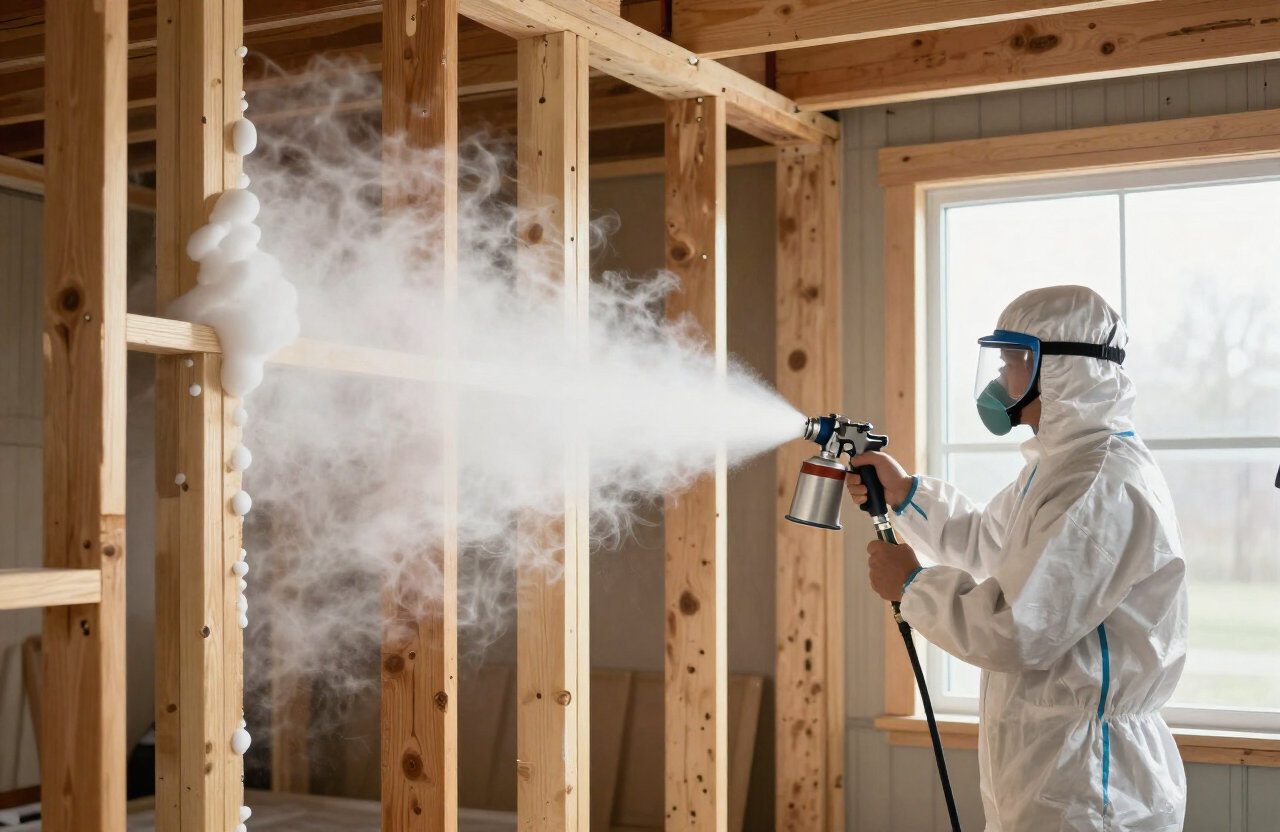
If you’re considering spray foam insulation, you’ve probably encountered two common options: open-cell and closed-cell foam.
Both can provide insulation and air sealing when properly selected and installed, but they behave differently.
Closed-cell spray foam typically provides more thermal resistance per inch and greater resistance to water vapor movement.
Open-cell spray foam generally has a lower R-value per inch, is more vapor-permeable, and may be suitable for applications where sufficient cavity depth is available.
So which one is better for your home?
The answer depends on the building’s design, local climate, moisture conditions, available space, budget, and applicable building codes.
Understanding the differences can help you make a more informed decision before hiring an insulation contractor.
What Is Spray Foam Insulation?
Spray polyurethane foam is an insulation material applied as a liquid mixture that expands and cures into foam.
It can conform to irregular surfaces and help seal gaps that allow air movement.
Spray foam is commonly used in building assemblies such as walls, rooflines, and other appropriate locations.
However, installation requires careful attention to the manufacturer’s instructions, substrate conditions, ventilation, fire protection, and applicable building codes.
Two major categories are low-density open-cell foam and medium-density closed-cell foam. For a broader overview of spray foam as an insulation option, see our spray foam insulation service.
What Is Open-Cell Spray Foam?
Open-cell spray foam has a relatively low density and a soft, flexible structure.
Many of its cells are not completely enclosed.
It typically expands substantially during application, allowing it to fill irregular spaces.
Common characteristics include:
- Lower R-value per inch than closed-cell foam
- Lower material density
- Greater water vapor permeability
- Air-sealing capability when installed at an appropriate thickness
- Greater thickness requirements for a comparable R-value
- Potential sound-attenuation benefits in some assemblies
Open-cell foam is often considered for interior applications with sufficient space.
However, its suitability depends on the building assembly and moisture-control strategy.
What Is Closed-Cell Spray Foam?
Closed-cell spray foam has a denser, more rigid structure.
Its cells are largely enclosed, producing different thermal and moisture characteristics.
Common characteristics include:
- Higher R-value per inch
- Greater rigidity
- Lower water vapor permeability
- Air-sealing capability
- Greater material density
- Higher material cost in many applications
- Potential contribution to assembly stiffness
Closed-cell foam can be useful where space is limited or where the design requires greater vapor resistance.
However, it must be selected and installed appropriately.
It is not a substitute for correcting active water leaks, damaged framing, or other building defects.
Values are general examples, not specifications for every product.
Actual performance depends on the manufacturer, product, thickness, installation, and tested properties.
Open-Cell vs. Closed-Cell Spray Foam at a Glance
The table below summarizes general differences between the two foam types.
| Characteristic | Open-Cell | Closed-Cell |
|---|---|---|
| R-value per inch | Approximately R-3.5 | Approximately R-6 |
| Density | Lower | Higher |
| Rigidity | Soft and flexible | Dense and rigid |
| Vapor permeability | More vapor-permeable | More vapor-resistant |
| Air sealing | Yes, at proper thickness | Yes |
| Thickness for comparable R-value | Greater | Lesser |
| Sound attenuation | Potential benefit | Less pronounced |
| Relative material cost | Often lower | Often higher |
Values are general examples, not specifications for every product. Actual performance depends on the specific product, thickness, and installation.
Not Sure Which Spray Foam Is Right for Your Home? Request a Professional Assessment.
Request a Professional AssessmentWhich Spray Foam Has a Higher R-Value?
Closed-cell spray foam generally provides a higher R-value per inch.
R-value measures resistance to heat flow.
A higher R-value indicates greater resistance to conductive heat transfer under the applicable test conditions.
U.S. Department of Energy technical guidance identifies typical values around R-3.5 per inch for open-cell foam and R-6 per inch for certain closed-cell products.
Specific products vary.
This difference matters when insulation space is limited.
For example, a shallow cavity may make it difficult to achieve a target R-value using a lower-R-value material.
However, higher R-value per inch does not automatically make a product the best choice for every wall or roof.
The entire assembly must be considered.
Does Open-Cell Spray Foam Require More Thickness?
Usually, yes, when the goal is to achieve the same nominal R-value.
Because open-cell foam generally has a lower R-value per inch, it typically requires more thickness than closed-cell foam to reach a comparable thermal resistance.
The exact thickness should be determined from the selected product’s tested performance and the project’s requirements.
Do not assume one standard application thickness is appropriate for every home.
Building codes, climate zones, and assembly design can influence the required insulation level.
Which Spray Foam Is Better for Air Sealing?
Both open-cell and closed-cell spray foam can provide effective air sealing when correctly installed at appropriate thicknesses.
Air sealing helps reduce uncontrolled airflow through the building envelope.
This can contribute to comfort and reduce certain heating and cooling loads.
However, air-sealing performance depends on installation quality and continuity.
Gaps, missed areas, poor adhesion, or other defects can compromise performance.
Spray foam should not be assumed to solve every source of air leakage throughout a home.
Which Spray Foam Is Better for Moisture Control?
Closed-cell foam generally provides greater resistance to water vapor diffusion.
Open-cell foam is more vapor-permeable.
That difference can be important, but moisture control is more complicated than simply choosing the least permeable insulation.
A building assembly needs an appropriate strategy for controlling:
- Bulk water intrusion
- Air leakage
- Water vapor movement
- Condensation
- Drying potential
A material that restricts drying in the wrong location may create problems.
Likewise, a vapor-permeable material may require additional vapor control in certain climates and assemblies.
An insulation professional should evaluate the complete wall or roof design.
Is Closed-Cell Spray Foam Waterproof?
Closed-cell foam is more resistant to liquid water penetration than open-cell foam, but describing every closed-cell product and installation as completely waterproof is misleading.
Its performance depends on product properties, thickness, seams, transitions, and installation.
It does not replace roofing, flashing, drainage, or other required water-management systems.
A roof leak or plumbing leak should be repaired before insulation is installed.
Spray foam should never be used to conceal an unresolved moisture problem.
Can Open-Cell Spray Foam Absorb Water?
Open-cell foam is generally more permeable to moisture than closed-cell foam.
Its behavior when exposed to water depends on the product and conditions.
If water enters an insulated assembly, the source should be identified and repaired.
Wet or damaged materials may require evaluation and replacement.
Do not assume that insulation can safely remain in place after every leak.
Which Spray Foam Is Better for Attics?
The answer depends on whether the attic is vented or unvented, the climate, and the roof assembly.
In a vented attic, insulation is often installed at the attic floor to separate the conditioned living space from the attic.
In an unvented attic, insulation may be installed along the roofline as part of a specifically designed assembly.
Open-cell and closed-cell spray foam may be used in certain roof assemblies, but their suitability depends on local code requirements, condensation control, and roof construction.
A contractor should evaluate:
- Existing attic ventilation
- Roof sheathing condition
- Climate zone
- Moisture risks
- HVAC location
- Required insulation levels
- Fire protection requirements
Do not convert a vented attic to an unvented assembly without an appropriate design.
Which Spray Foam Is Better for Exterior Walls?
Both materials may be appropriate for certain wall assemblies.
Open-cell foam can fill cavities and provide insulation and air sealing.
Closed-cell foam can provide more R-value in a limited space and greater vapor resistance.
However, the choice depends on the exterior cladding, water-resistive barrier, sheathing, climate, and ability of the wall to dry.
Adding low-permeance materials without understanding the assembly can create unintended moisture risks.
A professional evaluation is recommended.
Is Spray Foam Suitable for Crawl Spaces?
Spray foam can be used in certain crawl-space assemblies.
However, crawl spaces require careful moisture management.
Ground moisture, drainage, foundation conditions, ventilation, and local building requirements must be considered.
Closed-cell foam may be considered in some designs because of its moisture-related properties.
But neither foam type should be installed over unresolved leaks, wet framing, or untreated moisture problems.
The correct solution may also involve drainage, ground vapor control, air sealing, or other work.
Is Open-Cell Spray Foam Better for Soundproofing?
Open-cell foam may help reduce sound transmission in some assemblies because of its structure and ability to fill cavities.
However, soundproofing performance depends on the entire wall or ceiling system.
Important factors include:
- Mass
- Air sealing
- Decoupling
- Insulation
- Drywall layers
- Penetrations
- Flanking paths
Open-cell foam should not be marketed as a complete soundproofing solution.
If acoustic performance is the primary goal, compare tested assemblies rather than relying on insulation type alone.
Is Closed-Cell Spray Foam Stronger?
Closed-cell foam is generally more rigid than open-cell foam.
In some assemblies, properly installed closed-cell foam can contribute to stiffness.
However, it is not a substitute for structural framing, engineering, or repairs to damaged building components.
Any structural claims should be supported by product testing and the applicable design.
Which Spray Foam Costs More?
Closed-cell spray foam often costs more per unit of installed volume because of material and application differences.
However, total project costs depend on:
- Area being insulated
- Required R-value
- Application thickness
- Product selection
- Surface preparation
- Accessibility
- Labor
- Protective barriers
- Removal of existing materials
- Local conditions
Comparing price per square foot without considering thickness and R-value can be misleading.
A lower material price does not automatically mean a lower total project cost.
Ask contractors to provide written estimates specifying the material, thickness, R-value, and scope of work.
Planning an Insulation Project? Ask R&R Spray Foam for a Quote.
Ask R&R Spray Foam for a QuoteIs Closed-Cell Spray Foam Worth the Higher Cost?
It may be in some applications.
Closed-cell foam can be useful where space is limited or where the assembly benefits from its lower vapor permeability.
However, the additional cost may not be justified in every application.
Open-cell foam may be appropriate where cavity depth is sufficient and the moisture-control design supports its use.
The best value depends on the entire project.
Which Spray Foam Is Better for Energy Efficiency?
Both can contribute to energy efficiency when properly installed.
Energy performance depends on more than the foam type.
It also depends on:
- Installed R-value
- Air leakage
- Thermal bridging
- Building geometry
- HVAC performance
- Windows and doors
- Climate
- Installation quality
Closed-cell foam provides greater thermal resistance per inch, but an appropriately designed open-cell assembly can also meet insulation goals.
Actual energy savings vary by building.
No contractor should promise a fixed percentage reduction in utility bills without a credible building-specific analysis.
Does Spray Foam Prevent Mold?
Spray foam is not a mold-remediation treatment.
Appropriate insulation and air sealing can help manage some conditions that contribute to moisture problems.
However, mold can still develop where moisture is present.
Leaks, condensation, drainage problems, and excessive indoor humidity must be addressed.
If a building already has mold or water damage, those conditions should be evaluated before insulation work begins.
Do not spray foam over contaminated or damaged materials as a substitute for remediation.
Is Spray Foam Installation Safe?
Spray polyurethane foam installation involves chemicals that require proper handling.
The U.S. Environmental Protection Agency warns that exposure to certain spray foam chemicals, including isocyanates, can cause respiratory and other health problems.
Professional installation should include appropriate:
- Training
- Protective equipment
- Work-area isolation
- Ventilation
- Product handling
- Application procedures
- Curing conditions
- Cleanup
Unprotected occupants and other workers should not remain in the application area.
The contractor should follow the product manufacturer’s instructions and applicable safety requirements.
How Long Should You Stay Out of the House After Spray Foam Installation?
There is no universal re-entry time that applies to every spray foam product and installation.
The appropriate timing depends on the formulation, curing conditions, ventilation, and manufacturer instructions.
Ask the contractor for a written occupancy and re-entry plan before work begins.
Pets and other occupants must also be considered.
Do not assume a home is safe to re-enter simply because the foam appears dry.
Does Spray Foam Need a Fire Barrier?
Spray polyurethane foam is combustible and may require a thermal barrier, ignition barrier, or another code-approved protective assembly depending on the location and application.
Requirements vary by building code, occupancy, product, and installation.
Do not assume exposed spray foam is permitted in every attic, crawl space, or wall.
A qualified contractor should identify the applicable requirements before installation.
Can You Install Spray Foam Yourself?
Professional installation is generally advisable for larger residential projects.
Two-component spray foam systems involve chemical exposure risks, specialized equipment, and installation requirements.
Improper application can cause poor performance and potentially serious problems.
Homeowners should carefully review product safety information and local requirements before considering any DIY foam product.
Small one-component sealants are different from professionally applied whole-building insulation systems.
What Should You Ask a Spray Foam Contractor?
Before accepting a quote, ask:
- Which foam type do you recommend?
- Why is it appropriate for this assembly?
- What product will be installed?
- What R-value and thickness are specified?
- How will existing moisture problems be addressed?
- What ventilation or occupancy precautions are required?
- What fire protection is necessary?
- How will the work be inspected?
- What is included in the estimate?
- Are additional repairs or preparation required?
- What manufacturer documentation is available?
- What are the applicable warranty terms, if any?
A clear proposal should explain the work rather than simply naming a foam type.
Open-Cell vs. Closed-Cell: Which Should You Choose?
Choose based on the needs of the building, not a universal ranking.
Open-cell foam may be appropriate when:
- The assembly allows sufficient insulation thickness.
- Greater vapor permeability is acceptable or desirable.
- The product meets the required performance and code conditions.
- The project benefits from a lower-density material.
Closed-cell foam may be appropriate when:
- Insulation space is limited.
- Higher R-value per inch is important.
- The assembly calls for greater vapor resistance.
- The specified product meets the design and code requirements.
Both options require proper installation.
The final decision should consider climate, moisture, building design, product specifications, and total project cost.
Get Professional Advice About Spray Foam Insulation
Choosing insulation involves more than comparing product labels.
A professional should evaluate the space being insulated, the existing conditions, and the performance goals.
R&R Spray Foam offers spray foam insulation for homeowners and property owners across Connecticut and New York, including Westchester County.
You can reach R&R Spray Foam by phone at (475) 210-9327 or through the website’s contact form to discuss available insulation services and project requirements.
For more information about the overall benefits and drawbacks of spray foam, read our companion article Is Spray Foam Insulation Worth It? Costs, Benefits & Drawbacks.
Ready to discuss your insulation project? Contact R&R Spray Foam to request a project-specific assessment.
For more answers to common insulation questions, visit our FAQ page.
Get Started With Your Insulation Project.
Get StartedFrequently Asked Questions About Spray Foam Insulation
Open-cell foam is lower-density and more vapor-permeable. Closed-cell foam is denser, more rigid, and generally provides a higher R-value per inch.
Closed-cell foam typically has the higher R-value per inch, although actual values vary by product.
Open-cell foam often has a lower material cost, but the total project cost depends on thickness, labor, preparation, and required performance.
It offers greater moisture resistance, but it should not be treated as a universal waterproofing system or a replacement for proper drainage and leak repairs.
Yes, when installed at suitable thicknesses and according to product specifications.
It can be appropriate in certain attic assemblies. The decision depends on roof design, climate, moisture control, and code requirements.
No insulation material guarantees mold prevention. Moisture problems must be addressed separately.
The best option depends on the wall assembly, climate, drying potential, insulation requirements, and product specifications.
Proper product selection, installation, curing, ventilation, and manufacturer re-entry instructions are essential. Ask the contractor for a specific safety plan.
Contact R&R Spray Foam using the verified phone number or contact form on its official website.
For more answers, browse our full insulation FAQ page.
Request a Spray Foam Insulation Estimate
Spray foam insulation may improve comfort and energy efficiency when it is appropriate for the building and installed correctly. However, choosing the right product and installation method matters. If you’re considering spray foam insulation, contact R&R Spray Foam to discuss your project and request an estimate.
Sources & Further Reading
- U.S. Department of Energy. “Building America Best Practices: Energy Renovations, Insulation”
Technical information on open-cell and closed-cell insulation, thermal performance, moisture properties, and installation considerations. - U.S. Department of Energy. “Measure Guideline: Internal Insulation of Masonry Walls”
Comparison of insulation R-values and water vapor permeability. - U.S. Environmental Protection Agency. “Spray Polyurethane Foam Insulation and How to Use It More Safely”
Guidance on chemical exposure risks and safe installation practices. - U.S. Environmental Protection Agency. “Ventilation Guidance for Spray Polyurethane Foam Application”
Guidance on ventilation, containment, and occupant protection. - U.S. Environmental Protection Agency. “Safer Workplace Practices for Spray Polyurethane Foam Installation”
Guidance on professional practices, safety, and re-occupancy planning.